The Specialists Won. Now What? How We Learned to See Less
“Do I contradict myself? Very well then I contradict myself. I am large, I contain multitudes.” — Walt Whitman, Song of Myself

“Are you a lead player or an improviser?”
Both.
“Are you a striker or a grappler?”
Both.
“Why do you train with weapons and firearms if you practice martial arts?”
Training with weapons and firearms IS martial arts.
“Why are you seeing a MD — I thought you were a TCM practitioner?”
I am. In China they use both seamlessly — not by watering either down, but by seeing them as a complementary toolbox in service of the patient.
“I thought you went to school for jazz performance. Why are you taking a classical symphonic analysis class?”
Because I love music.
“Brother, you shouldn’t read Ibn Arabi — that is bida’ (innovation in a negative sense, i.e. misguided). Stick with Ibn Taymiyya. Only do what the Prophet did.”
But brother how did you get to New York City?
“The subway.”
Did the Prophet ride a train?
“Excuse me sir… have you accepted Jesus as your savior?”
No. I think the one who saves me is the one who created me — the one Jesus fell on his face and prayed to.
These are not separate conversations. They are the same conversation, asked across different arenas, different decades, different disciplines. And the question underneath all of them is the same:
Why are you more than one thing?
The Narrowing
Somewhere in the last two centuries, we made a decision — not all at once, not consciously, but decisively — that depth meant narrowness. That expertise meant exclusion. That to truly know something, you had to stop looking at everything else.
It wasn’t always this way. And it wasn’t this way in only one place.
Shen Kuo, writing in 11th century Song dynasty China, produced a single book — Dream Pool Essays — that moved across astronomy, pharmacology, geology, mathematics, and poetry without pausing to apologize for the range. It wasn’t encyclopedism. It was one mind following one question through every available instrument.
Nezahualcoyotl ruled Texcoco in 15th century Mesoamerica, built the great dike that protected the lake cities, wrote philosophical poetry of a sophistication that still unsettles scholars, and developed a theology that some argue was functionally monotheistic well before Spanish contact. Ruler, engineer, poet, theologian. The categories didn’t conflict. They informed each other.
Miyamoto Musashi — whom most people know as a swordsman — spent the last years of his life painting, sculpting, and writing what is explicitly a theory of perception, not a fighting manual. The Book of Five Rings is an argument about how to see. The sword was just the domain in which he first learned to see it.
Amadou Hampâté Bâ was a 20th century Malian scholar, oral historian, ethnographer, diplomat, and Sufi initiate who devoted his life to preserving the intellectual traditions of the Sahel before they disappeared. He understood that knowledge lives in people, not institutions — and that when the people die untranscribed, the knowledge dies with them. “In Africa,” he said, “when an old man dies, a library burns.”
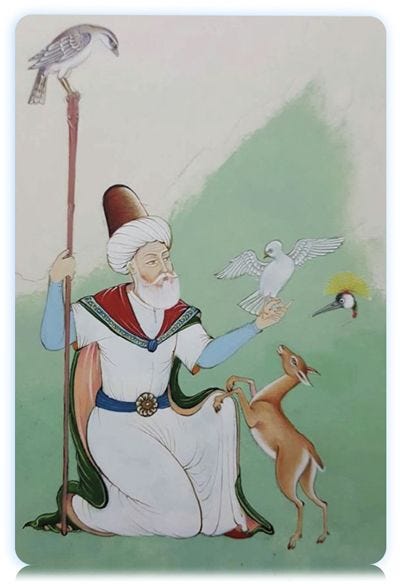
The medieval Islamic world held this same premise at its philosophical core — that knowledge was not a collection of separate rooms with locked doors, but a single inquiry conducted through multiple instruments simultaneously. Ibn Arabi — the 12th century Andalusian mystic whose metaphysics now forms the core of my doctoral dissertation — was simultaneously poet, jurist, philosopher, and systematizer of mystical experience so rigorous it has occupied scholars for eight centuries. He didn’t experience these as competing identities. They were facets of a single question: what is the nature of reality, and what is the nature of the human being who perceives it?
The Renaissance tried to hold this vision together. Leonardo da Vinci is the obvious archetype. But Leonardo was already, in some sense, playing defense. The fragmentation had already begun. The guilds were forming. The disciplines were building walls.
And then the industrial model colonized the university. Knowledge became a means of production. Expertise became a commodity. The specialist became the ideal — deep, narrow, credentialed, legible to institutions. The generalist became suspect. A dabbler. Someone who hadn’t committed.
We’ve been living in that world ever since.
What Specialization Costs
Let me be clear: this is not an argument against specialization per se. The surgeon who operates on your spine should be a specialist. The engineer who designs the bridge you drive across should be a specialist. Depth matters. Rigor matters. Years of focused practice matter enormously.
I know this because I’ve lived it — as a professional trumpeter who spent decades on tour, in the recording studio, and on Broadway performing eight shows a week; as a licensed acupuncturist running a clinic in New York City; as a doctoral student in classical Daoist medicine; as a lifelong martial artist. None of those things are casual. All of them required the kind of sustained, focused commitment that specialization demands.
But there is a cost when one mistakes focus for narrowness. And the cost is this:
Specialists often cannot see when the problem in front of them is the same problem someone already solved in a completely different field.
Physicists rediscovering what contemplatives mapped centuries ago. Neuroscientists describing states that meditators have been cataloguing in precise phenomenological detail for millennia — and treating their own findings as new. Epidemiologists and political scientists failing to recognize the same authoritarian pattern playing out simultaneously in public health institutions and democratic governance, because they’re each looking at it through a single disciplinary lens.
The same week I was asked about hantavirus — is it treatable, what’s the prognosis — a cruise ship sat isolated off the South African coast with a deadly outbreak on board, three passengers dead, the strain not yet identified. And in the same breath, we found ourselves talking about the systematic dismantling of the CDC, the degradation of the WHO relationship, the installation of unqualified ideologues into public health infrastructure.
A specialist sees a virology problem. And separately, a political science problem.
Someone trained to see across domains sees one problem: what happens to collective perception when the institutions that organize it are deliberately corrupted. That’s not a virology question. It’s not a political science question. It’s a question about epistemology — about the sociology of knowledge, about what Ibn Arabi would call the corruption of the perceiving faculty — the systematic dismantling of the capacity to orient toward truth.
It requires multiple lenses held simultaneously to even see it clearly.
Doing Your Own Research
I treat a lot of combat athletes in my clinic. Grapplers, strikers, MMA fighters — serious practitioners who have spent years mastering extraordinarily complex physical and strategic disciplines. I have profound respect for what they do and what it costs them.
Post-COVID, many of them arrived with firm views about vaccines, about pharmaceutical medicine, about institutional science. They had “done their own research.”
I stopped arguing about it. Not because the argument isn’t worth having — it is, especially when we’re talking about transmissible disease, where individual choices become public health externalities — but because debate in the clinical setting is rarely the right venue.
Instead I ask a question.
Does someone playing a UFC video game have the same level of qualification as a professional fighter who has trained for years?
They always know the answer. They’ve had that exact conversation defending their own training to someone who thinks watching fights on television makes them an expert.
What I’m doing is asking them to apply the epistemological standard they already hold — that expertise is real, that it’s earned through years of specific work, that there is a genuine difference between knowing and performing knowing — consistently across domains.
It’s a version of the train question. Did the Prophet ride a train?
Tradition is not the same as literalism. Expertise is not the same as credentialism. And the ability to search something on the internet is not the same as the capacity to evaluate what you find.
The tragedy of the post-COVID epistemological landscape is not that people became skeptical of institutions — some of that skepticism was earned. The tragedy is that the skills required to evaluate evidence, to trace causation across complex systems, to hold uncertainty without falling into either blind trust or reflexive rejection — those are precisely the skills that a culture of narrow specialization never developed in the first place.
Hannah Arendt wrote that the goal of authoritarian information strategy isn’t necessarily to make people believe false things. It’s to make them feel that nothing is truly knowable. An exhausted, cynical population that has given up on truth is far more manageable than one that is merely misinformed.
The specialist culture prepared us perfectly for this moment — and not in a good way. When you’ve never been trained to see patterns across domains, when your entire educational formation told you to stay in your lane, you have no tools for the moment when the lane itself is being deliberately flooded.
And here is the thing that took me a long time to understand: the antidote isn’t more information. It’s a different kind of perception. The capacity to recognize when the same pattern is playing out in different clothes — in a body, in a body politic, in a century-old philosophical text — is not a gift. It’s a practice. It has to be built, the same way you build a submission defense or a pulse diagnosis: through years of working the same problem from enough angles that the underlying structure finally becomes visible.
The Well and the Layers
I’ve been drilling the same well for a long time. The forms have changed — trumpet, recording studio, clinic, classroom, boxing ring, dissertation, this essay — but the underlying question has stayed essentially constant.
What happens to perception when it gets distorted? And how do you restore it?
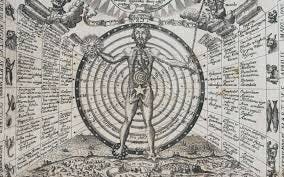
In individuals, in culture, in history, in the body — it’s the same question. The Five Shen model in classical Chinese medicine is a map of how perception organizes itself across different registers of human experience. Ibn Arabi’s metaphysics of imagination — the barzakh, the isthmus where apparently opposing realities meet without collapsing into each other — is a map of how a mind stays coherent while holding genuine complexity.
These are not separate projects. They are the same project, conducted through different geological layers.
What the polymath cultivates — and what specialization systematically discourages — is the capacity to recognize isomorphic structures across different domains. To see that the problem of immune response and the problem of political radicalization and the problem of a patient who can’t integrate contradictory information about their own health are all, at some level of abstraction, the same problem.
Not identical. Isomorphic. Same shape, different substance.
Both
I am a trumpet player and an acupuncturist and a doctoral student and a martial artist and a writer. Not sequentially. Simultaneously.
It has cost real things — sustained focus, the comfort of a clear professional identity, the ease of fitting into existing categories. There are days it feels like being several people who have to share one body and one schedule.
But when I walk into a room, be it a clinic, a classroom, a tour bus, a jiu-jitsu mat — I can see the thing that the person trained only in that room cannot see, I understand what I’ve been building. Not a career. A perceptual instrument. One that took four decades to tune and will probably take another four to fully understand. The problems that actually matter right now — and you know which ones I mean — are not going to yield to any single lens. They never have. We just spent two centuries pretending otherwise, and we are living in the consequences.
Maybe we start by stopping the apology. Stopping the explanation of why we are more than one thing, as if multiplicity requires a defense.
Maybe we start treating pattern recognition across domains not as a personality quirk but as a discipline — one that can be cultivated, taught, modeled.
Maybe we start asking, in our clinics and classrooms and conversations, not just what do you know but what can you see.
The polymath isn’t a relic. The polymath is what this moment requires.
Both. Always both.
A Note on Three Terms
Bida’ — In Islamic jurisprudence, unlawful innovation: a departure from established tradition considered misguided or forbidden. Used here to illustrate how the question of authority and legitimacy plays out inside religious communities, just as it plays out inside academic disciplines.
Barzakh — From Ibn Arabi’s metaphysics: the isthmus, the intermediary space where apparently opposing realities meet without collapsing into one another. The word that comes closest, in any tradition I know, to describing what a genuinely cross-disciplinary mind actually does.
Shen — In classical Chinese medicine, often translated as ‘spirit’ or ‘mind,’ though neither fully captures it. The Shen encompasses consciousness, perception, and the capacity for self-awareness — the faculty that gets distorted when the institutions that organize collective truth are deliberately corrupted.
Barry Danielian is a licensed acupuncturist (L.Ac.) and a board-certified herbalist. Currently a doctoral candidate at Daoist Traditions College of Chinese Medical Arts, where he studies within the Jade Purity lineage of renowned Master Jeffrey Yuen. He has, for 40 years been one of the most in-demand trumpet players in NYC, and longtime member of the E Street Horns. He writes at the intersection of music, classical Chinese medicine, martial arts and spirituality. Bridging ancient wisdom with modern life.
Or a little more succinctly: everything informs practice - everything