TOURING with BRUCE SPRINGSTEEN and SPLEEN QI DEFICIENCY
"When the spleen is healthy it can generate all living things. If it becomes depleted, it can bring about the hundred diseases." - The Neijing

I’ve now toured the world with Bruce Springsteen twice. The first time, 2012-2014, I came home depleted in ways I didn’t understand. The second time, 2023-2025, I came home having treated myself and much of the band and crew using Chinese medicine—and understanding exactly why the first tour wiped me out.
The difference? On the second tour, I was a licensed acupuncturist and herbalist who understood Spleen Qi deficiency.
In 2014 I had just finished that first world tour with Bruce and subsequently decided to enroll in Chinese Medicine school. It had been something I’d considered for almost 20 years—I finally pulled the trigger.
I’m sitting in my first Foundations class, learning about the principles of channels, organ systems, and what constitutes health and wellness in the view of TCM. Then the professor starts talking about the prevalence and causes of Spleen Qi deficiency: irregular lifestyle and sleep, eating out, eating too late at night, staying up late, sleeping during the day, too much stress (even if it’s for a good purpose).
I’m thinking to myself: “You just described my entire life and that of every musician I know!”
Despite the dire picture being painted, not much changed for me. I would be in classes all day, grab a quick bite, hop on the subway, and rush to make the 8pm downbeat at my Broadway show. Home by 11:30pm, starving, then I’d have dinner. This went on for five years until I graduated and, as fate would have it, Covid hit.
During those years, no matter how many hours I slept, I never felt rested. I maintained my martial arts training, mostly for my mental health, but even then, I never felt quite as sharp or quite as strong. The didactic part of school was intense—memorizing close to 370 acupuncture points and their functions, nearly 450 single herbs, and 160 herbal formulas, on top of all the theory and philosophy.
The guys at the Broadway show thought I was nuts. I had my notes and study guides on my music stand (I had the music memorized) and would study in between “Conga,” “Rhythm is Gonna Get You,” and “Get On Your Feet.” Not surprisingly, my capacity to retain information began to fail me and I walked around feeling pretty cloudy-headed most of the time.
Looking back now with nearly a decade of internship and clinical practice, I can see the pattern with crystalline clarity. What I was experiencing wasn’t just “being busy” or “burning the candle at both ends.” It was a systematic depletion of what Chinese medicine calls Spleen Qi—and understanding this framework helps explain not just what was happening to me, but what’s happening to a huge swath of people living fast-paced modern lives.
So what exactly is Spleen Qi, and why does it matter?
In Traditional Chinese Medicine, the Spleen (working in partnership with the Stomach) is responsible for what we call “transformation and transportation.” It takes in food, breaks it down, and transforms it into usable Qi and Blood that nourishes your entire system. Think of it as your metabolic command center.
But here’s what makes the Spleen unique: it doesn’t just transform food. It transforms everything—experience, information, emotion, sensory input. It’s the organ system that processes life itself and converts it into something your body and mind can use.
When Spleen Qi becomes deficient, several things happen: digestion becomes unreliable, energy levels become unstable (especially after eating), thinking becomes cloudy or obsessive, and there’s a particular quality of tiredness that rest doesn’t quite fix. You might crave sweets, experience loose stools or bloating, feel heaviness in your limbs, an a chronically weakened immune system.
The Spleen “governs the muscles and the four limbs” in TCM—when it’s strong, you feel embodied and capable. When it’s weak, even inhabiting your body feels like work.
Sound familiar?
Chinese Medicine has a 24-hour clock system in which Qi circulates through all the organ systems in a continuous cycle. Spleen time is 9-11am—when its transformation and transportation functions are at their strongest. For most musicians, me included, we’re sound asleep at this time.
Remember my after-show dinner at 11:30pm? According to this clock system, I was eating my biggest meal precisely when the Spleen’s energetics were at their weakest—12 hours opposite its peak function. It’s no wonder I never felt restored by sleep or that my body always felt heavy. Remember the “transformation and transportation” aspect? This function is very much hindered by irregularity, be it in sleep patterns or your eating schedule. Not unlike a supply chain system, it will not function effectively if it doesn’t know when things are arriving or leaving.
This doesn’t happen overnight. The occasional late-night meal won’t necessarily cause Spleen Qi deficiency, but when it becomes a lifestyle pattern, a progression is set in motion that can have real consequences.
With that, let me step into the confessional for a moment—with the assumption that I’m probably not alone in these habits.
I’d get home from the show around 11:30pm or midnight, cook up a steak and veggies, and pat myself on the back for making a good food choice. Ha! A good choice for breakfast, maybe—not so good for a midnight meal. After eating and realizing I wasn’t tired yet, what better way to wind down than watching MMA and polishing off a pint of Ben & Jerry’s Cherry Garcia? After all, I was taking a full course load, getting great grades, still going to the boxing gym, playing eight shows a week. I’d burn off these calories just sitting in herbs class, right?
My Spleen was starting to really not like me. But I wasn’t done.
I’d wake up not feeling rested, pound down two cups of coffee, take the train into school while studying frantically because I HAVE to get at least a 95% to be happy. Classes done, pissed off that I only got a 93%. My classmates would remind me, “You only need a 70% to pass.” This pissed me off even more. I’d hurry to shove anything in my stomach—usually nothing very healthy—and race to my show where I was demanding perfection of myself.
In TCM terms, this is the emotional manifestation of dampness and phlegm that the Spleen really doesn’t like: obsessive thinking, perfectionism, the inability to let things go. I was overthinking, overworking, and under-nourishing—the perfect recipe for Spleen Qi collapse.
The fascinating thing is how much this ancient framework aligns with what Western medicine understands about these same systems.
Western medicine recognizes the spleen’s role in blood production and immune function—it’s where old red blood cells are recycled and immune responses are mounted. The pancreas, intimately connected in both location and function, regulates blood sugar through insulin and produces digestive enzymes.
When TCM talks about the Spleen “producing Blood,” we’re describing what Western medicine confirms: the transformation of nutrients into blood components. When we say it “transforms and transports,” we’re talking about what endocrinology calls metabolic regulation and gastroenterology calls digestive function.
The connection between digestive distress, mental fog, fatigue, and blood sugar dysregulation isn’t mystical—it’s physiological. The irregular eating, the stress, the cognitive demand, the lack of rest—all of it taxes these interwoven systems in ways both paradigms can recognize.
Your cortisol is chronically elevated. Your blood sugar is on a roller coaster. Your digestive enzymes are being called upon at suboptimal times. Your immune system is running on fumes. Chinese medicine just understood these connections centuries before we had labs to measure them.
Despite my best efforts to trash my Spleen, I managed to graduate with a 3.67 GPA and won the Nu-Herbs scholarship award. I squeezed in an extra 10-week course on Tung’s acupuncture, passed my national board exams, and got licensed to practice in three states.
Then Bruce called for another world tour. Of course I said yes.
The difference this time? I wasn’t just a trumpet player—I was a practitioner of Chinese medicine. I was excited to offer treatments and knowledge to help my road family in whatever way I could, and perhaps to help myself avoid the pitfalls that had nearly broken me the first time around.
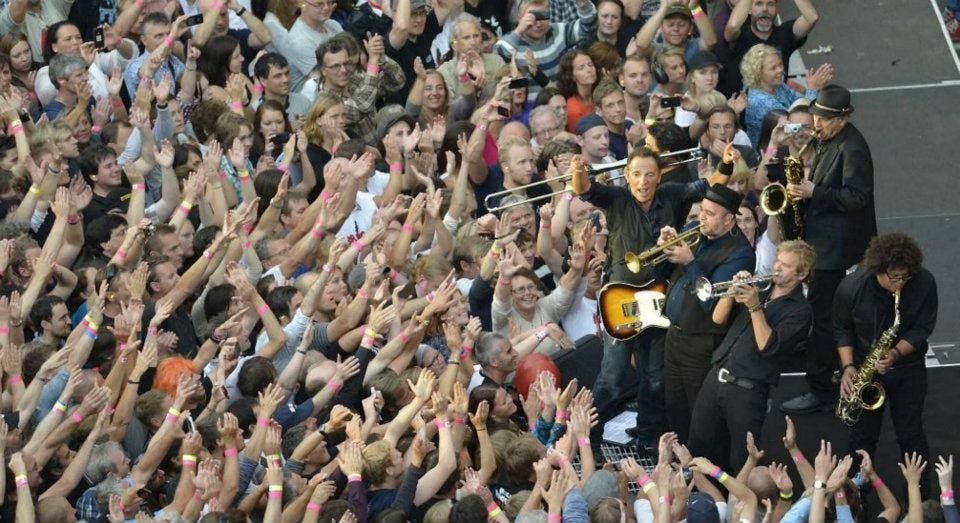
Some things were unavoidable. The travel schedule is what it is. Shows are at night. Bruce is known for giving the audience literally everything he has. After the long, uncertain Covid shutdown, I began to view what we do as a big New Jersey-style injection of joy, passion and emotion. We delivered that, and then some to millions and millions of people all over the world.
But what about Mr. Spleen and his seemingly untenable demands?
For me, I made an effort to apply as much regulation as I could during the daytime before show nights. On off days, I was disciplined with time management and routine. We have a very health-conscious band, so there’s a built-in support system—hitting the gym together, eating healthy food. I even got a bunch of us doing the “1,000 steps after meals” to stimulate the lower He-Sea points and aid digestion, straight out of the TCM playbook.
As we approached the stage each night and heard the crowd roaring and singing, I reminded myself of the mindfulness that both the Spleen and the Spirit crave. I reminded myself that just a short while ago we were all in Covid lockdown and unable to perform live. That we’re in the joy business, not the overthinking perfectionist business. This mental shift alone allowed me to feel energized by the shows rather than wiped out like the previous tour.
What amazed me—and what became a recurring theme—was that despite the variety of complaints I was treating in the “E-Street clinic” (lumbar pain, sore knees, tweaked shoulders, long Covid, insomnia), I kept seeing the same underlying pattern: slippery, weak pulses, especially in the right guan position (the Spleen position); pale tongues with white coating and scalloped edges. Everyone had varying degrees of digestive issues, Brain fog and an overall sense of body heaviness.
Initially, I was treating each condition symptomatically—branch treatments, focusing on getting people out of pain quickly. I got good results, but not great results.
Then I started to realize the degree to which Spleen Qi deficiency was showing up in nearly every case. I decided to shift my approach: treat the root pattern—the Spleen deficiency—regardless of where the aches and pains were located.
Nearly every case improved dramatically. Beyond the pain resolving, everyone reported better sleep, more consistent energy, greater mental clarity, and much less brain fog.
This was a powerful lesson for me as a relatively new practitioner. We want quick results, and there’s nothing wrong with that. But the real power of this medicine lies in discerning the root pattern of disharmony and treating that.
It’s almost like in music: you can revoice a chord ten different ways to try to make it work with the melody but sometimes it’s just not the right chord for the melody.
With all of that in place and optimized, we were more than ready to transform and transport our audience to what Bruce refers to as “Higher Ground.”
And the view from there is beautiful.